Why so many older fire doors contain asbestos
For most of the twentieth century, asbestos was the obvious material for a fire door. It doesn’t burn, it insulates, and it was cheap. Australia was one of the highest users of asbestos per person in the world until the mid-1980s.
A typical fire door from that era has a core of compressed asbestos or asbestos millboard inside a timber, veneer or steel skin. Some were faced with cement sheet, and some had a tape-like mastic insulation around the edges. The NSW Government’s asbestos site describes the core as friable — soft enough to crumble and release fibres, which is the more dangerous kind.
The bans came in stages. Most states stopped the manufacture and installation of products containing blue and brown asbestos from the end of 1984, asbestos was out of building products in most states by the late 1980s, and a total national ban started on 31 December 2003. So a fire door installed before the late 1980s is the one to be most suspicious of.
Those doors are still around. In many buildings the stairwell doors on residential floors have been replaced over the years, while the doors to plant rooms and lift motor rooms were left in place. Switch rooms and substations are other common spots. A fire-rated panel above a door can have the same core as the leaf, and it may not carry a tag.
How to tell whether a fire door might contain asbestos
You can’t tell by looking. The only way to be sure is to have a sample tested by a laboratory accredited by NATA (the National Association of Testing Authorities). Until then, the rule from SafeWork NSW is simple: if it could be asbestos, treat it as asbestos.
What you can do safely is gather clues without touching anything:
- The asbestos register. Workplaces built before 31 December 2003 must keep one, and it should list known or assumed asbestos fire doors. Look there first.
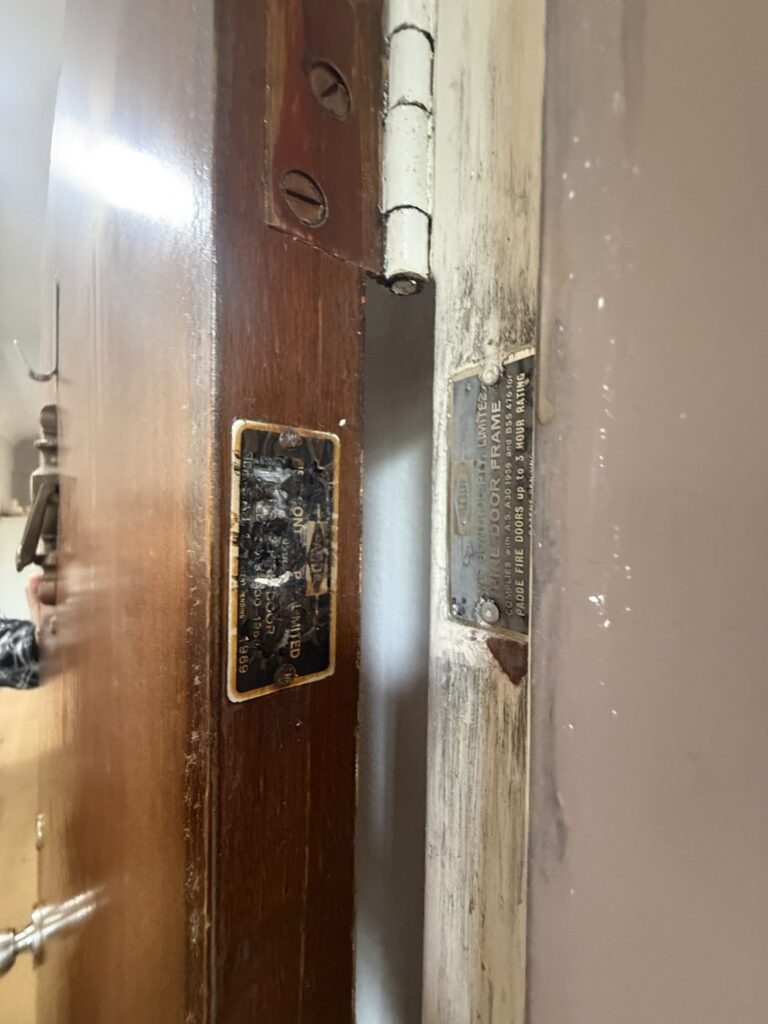
- The tag. A fire door’s metal tag usually gives its year of manufacture. A year before the late 1980s is a strong warning sign. Our guide to fire doors explained shows where to find the tag and how to read it.
- An “asbestos-free” label. Fire doors from the early 1980s on may be labelled asbestos-free. Without that label, an older door should be treated as containing asbestos. So should a door with no tag at all.
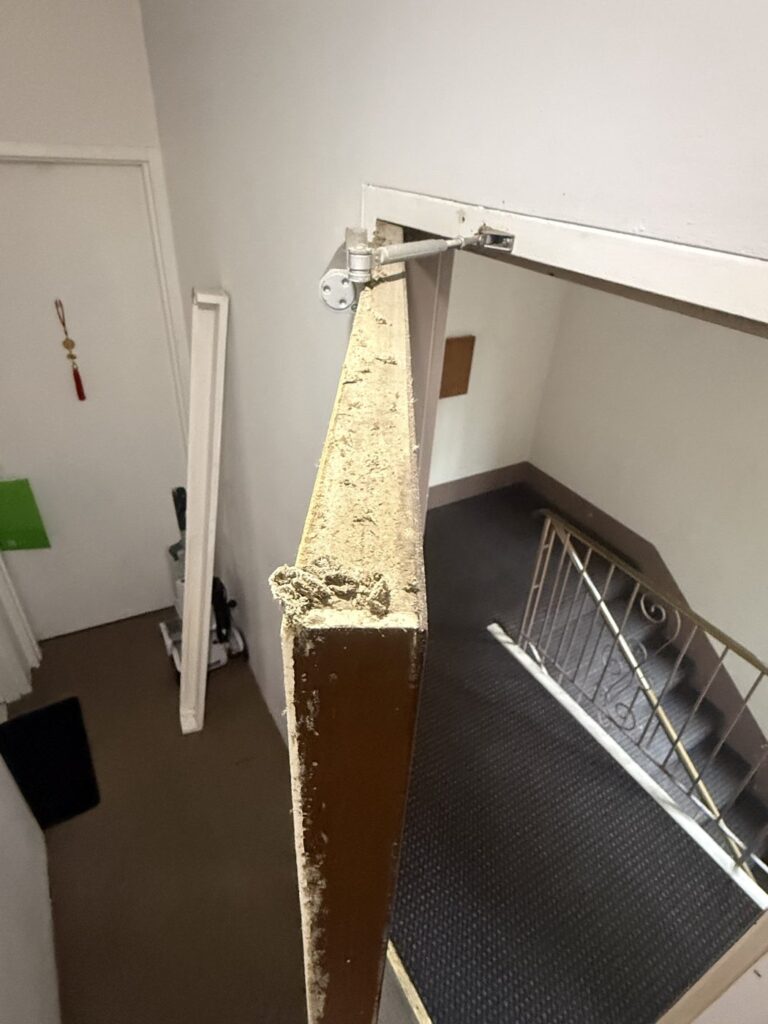
- Weight and the top edge. Asbestos-core doors are noticeably heavy. On many, the core is visible along the top edge of the leaf, between the faces. A core built up in layers, like a laminate, is one of the strongest visual signs of asbestos, and the core often looks white or grey. Look from a step ladder, but don’t scrape or probe it.
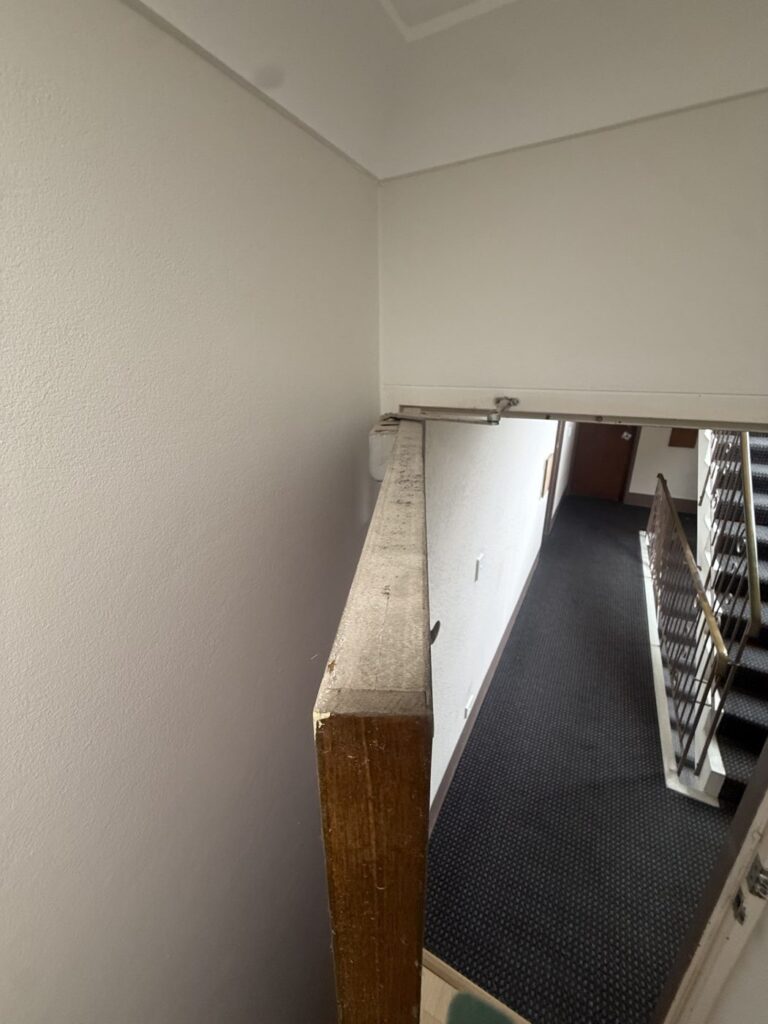
Please don’t take a sample yourself. Cutting a piece out of a friable core is exactly the kind of disturbance that releases fibres. SafeWork NSW strongly recommends that a competent person, such as a licensed asbestos assessor, collects any sample.
Newer doors aren’t automatically in the clear
In 2025, the Australian Border Force found chrysotile (white) asbestos in an imported fire-rated core board used to make fire doors. The board was imported between 2021 and May 2025, and doors built with it were installed in buildings around Australia.
These doors look like any other modern fire door. The core is sealed inside the leaf and carries no markings. Regulators say the risk is very low while the door is intact, and rises when work disturbs the core — replacing hardware, for example. Doors made with that board are now prohibited from installation, and those already installed must go on the asbestos register for future removal.
If your fire doors were installed between 2021 and mid-2025, ask the installer or manufacturer whether that core board was used. Until you have an answer, treat the doors as you would an older one before anyone drills into them.
What SafeWork NSW requires
In NSW, asbestos at work is governed by the Work Health and Safety Act 2011 and the Work Health and Safety Regulation 2025, which replaced the 2017 Regulation. SafeWork NSW explains how to comply in two codes of practice: How to manage and control asbestos in the workplace and How to safely remove asbestos. The parts that matter for fire doors:
- Keep a register, and share it. A workplace built before 31 December 2003 must have an asbestos register, available to anyone who will work there. Where asbestos has been found, there must also be an asbestos management plan.
- Only a Class A licence removes a friable core. Any amount of friable asbestos needs a Class A asbestos removal licence. NSW also issues a Class A “fire doors and safes only” licence for exactly this work. You can check a removalist’s licence on Verify.licence.
- SafeWork is told first. The licensed removalist must notify SafeWork NSW at least five calendar days before removing any friable asbestos. In an emergency they phone first and lodge the notice within 24 hours.
- An independent assessor watches the air. Whoever commissions Class A work must engage an independent licensed asbestos assessor to monitor the air during removal. The same assessor inspects the area afterwards and issues a clearance certificate before anyone goes back in.
- The waste is tracked. Asbestos waste goes only to a site the NSW Environment Protection Authority authorises. Loads of 100 kg or more are tracked from the building to the landfill.
A note for strata. SafeWork NSW says an owners corporation responsible only for purely residential common property is generally not a PCBU (a “person conducting a business or undertaking”, the person who carries the main safety duties). That changes if it employs someone or the building is mixed-use. Either way, every contractor who works on your doors is a PCBU, so tell them about any asbestos door before they arrive.
How an asbestos fire door is removed safely
A fire door does a job every minute of the day, so the replacement is planned before the old door comes out. The national safety alert makes the same point: remove the door once a replacement is available, so the wall’s fire protection isn’t lost in the meantime. A typical job runs like this:
- Confirm or assume. Check the register. Where it’s silent, a licensed asbestos assessor samples the core, or the door is simply assumed to contain asbestos.
- Measure and make the new doorset. The opening is measured and the new fire door made to fit, so it’s ready to go in as soon as the old one is out.
- Engage the licensed people. A removalist holding the right Class A licence, and a separate licensed assessor for air monitoring and clearance.
- Notify and plan. The removalist notifies SafeWork NSW, writes an asbestos removal control plan and a safe work method statement, and gives notice to the people who commissioned the work, occupiers and immediate neighbours.
- Set up. Barriers and asbestos warning signs go up around the area. Workers wear disposable coveralls and fitted respirators. Wet methods keep fibres down; high-pressure water and compressed air are banned outright.
- Remove. The leaf comes off its hinges and is sealed and labelled as asbestos waste, along with any fire panel above it. The air is monitored throughout.
- Clear. The assessor inspects the area and issues a clearance certificate. Only then is it reopened.
- Install and record. The new doorset goes in with its compliance documentation, the asbestos register is updated, and the waste goes to an authorised landfill with its tracking record.
What asbestos means for fire door maintenance
Fire doors must be inspected and tested every six months under AS 1851-2012; sole-occupancy unit (SOU) fire doors — the front doors of individual apartments or tenancies — can be extended to once every 12 months. Opening, closing and looking over an intact asbestos door is low risk. Fixing one is another matter.
Most fire door repairs go into the leaf. A new closer, hinges, a lock or a latch all mean drilling or screwing, and on older doors these parts may sit directly against the asbestos core. WorkSafe WA has reported several incidents where workers were exposed to asbestos while repairing fire doors. Under the WHS rules, drills and other power tools can only be used on asbestos with the dust enclosed or captured.
In practice that changes three things:
- Simple repairs stop being simple. A closer swap on an asbestos door needs the register checked, the dust controlled, and often a licensed removalist and assessor. The paperwork and set-up can outweigh the repair.
- Defects linger. When a repair is hard to arrange, the defect stays on the inspection report. Unfixed fire door defects are one of the things that hold up the Annual Fire Safety Statement — the yearly declaration that a building’s fire safety measures are being maintained.
- Damage becomes urgent. A door that has been kicked, forced or split can expose its core. Keep people away from it, don’t sweep or vacuum the debris, and get a licensed asbestos assessor in.
For fire protection companies: before anyone fits hardware to an older fire door, check the site’s register. If the door isn’t listed and has no asbestos-free label, treat it as asbestos until it’s proven otherwise.
Why replacing them all at once usually costs less
Much of the cost of removing an asbestos fire door has nothing to do with how many doors there are. Every licensed job carries the same fixed steps — notification, set-up, an independent assessor, clearance — whether it’s one door or twenty. Replace doors one at a time and you pay for those steps every time. Replace them in one package and you pay for them once.
| One door at a time | Every asbestos door in one package | |
|---|---|---|
| SafeWork notification | A notice and a five-day wait for each job | One notice, one lead time |
| Removalist set-up | Barriers, signs, decontamination and a supervisor on site, every visit | Set up once for a planned run of doors |
| Independent assessor | Air monitoring and a clearance inspection for each job | One engagement covering the whole program |
| Plans and notices | A control plan, safe work method statement and neighbour notices each time | Written once |
| Measuring and manufacture | One opening measured, one door made, each time | Every opening measured in one visit, made in one batch |
| Resident access | A new round of notices and access for each door | One round |
| Afterwards | The remaining doors stay on the register, and every repair to them is asbestos work | No asbestos fire doors left; maintenance goes back to normal |
There are quieter savings too. One quote means one approval, rather than the same decision coming back to every committee meeting. Matching doors and hardware are simpler to maintain. And the asbestos register gets shorter, which every future contractor will thank you for.
The most expensive way to deal with an asbestos fire door is in a hurry. A door that’s damaged or exposed needs urgent removal on someone else’s timetable, and SafeWork NSW notes it is cheaper to test and remove asbestos properly than to clean up contamination after it has been disturbed.
If the budget won’t stretch to every door at once, stage it sensibly. Group the doors by floor or area so each stage still shares one set-up. Start with any door that is damaged, has defects waiting on repair, or is due for hardware work.
How we handle asbestos fire doors
We replace fire doors, including in older buildings. Every opening is measured with digital templating, so each new doorset is made to fit its opening and is ready to go in when the old door comes out. Asbestos removal is separate from our replacement work — and we’ll tell you before anything is touched, not afterwards.
If you’re not sure which of your doors contain asbestos, an AS 1851 inspection gives you a service report with photos and an electronic door register — a starting point for working out where the older doors are. Request a quote for one door, a floor, or the whole building.